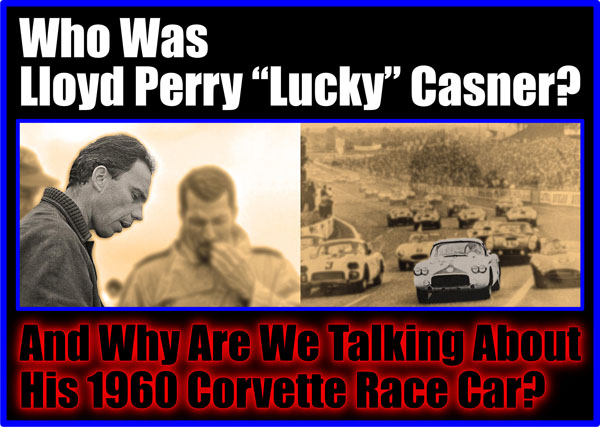
Who Was Team Owner and Racer, Lloyd Perry “Lucky” Casner?
And Why Are We Talking About His 1960 Corvette Race Car? This story first appeared in the August 2024 issue of Vette Vues Magazine. Lloyd...

And Why Are We Talking About His 1960 Corvette Race Car? This story first appeared in the August 2024 issue of Vette Vues Magazine. Lloyd...

Before the ZR-1 headlines and LT1 performance gains, Chevrolet proved the C4 Corvette’s capability on the track with the Corvette Challenge Series. Dan Binks’ 1989 factory-built race car is a perfect example of how close these machines were to showroom stock—and how dominant they became in SCCA competition. With minimal modifications and factory backing, these Corvettes blurred the line between street car and race car, giving enthusiasts a rare look at what a competition-ready C4 really looked like.

I’d like to introduce you to two “gasoline in the veins” kinds of guys. George Haddad from Fort Lauderdale, Florida has been a hot rod builder for over 45-years. Doug Whyte learned his modeling craft though his work for The Danberry Mint. The die-cast, articulated cars and trucks that Danberry Mint is well known for is extraordinary.

Dateline: 8-3-22, Photos by K. Scott Teeters, except where noted. This story first appeared in the July 2022 issue of Vette Vues Magazine – When...

John Greenwood is a legend in the world of Corvettes. Through the ’70s, while production Corvettes struggled to maintain as much performance as possible, John and his brother Burt built a series of stunning C3 Corvette race cars. Arguably, the most famous of the Greenwood Brothers Corvettes was their famous “Batmobile” very wide-body Corvette that was more aerodynamic, and produced lots of down-force on the car’s huge racing slicks. Greenwood needed as much traction as he could get to better work his ZL-1 427 engines, rumored to be making upwards of 700-hp, perhaps more!

Ride along with Didier Andre in the Spirit of America 1977 Greenwood Corvette.
This is as vicious as it gets Corvette fans. Oh, the sound of a big-block Chevy engine with open headers working through the gears.
Turn it up LOUD, hear and feel the POWER!

Unlike today’s Corvette Racing Team’s massive year-around, non-stop R&D program, the Sebring cars were prepared in just a few weeks and were being worked on around the clock. But all things considered, it was a valiant effort that paid off. Here’s a list of the modifications made to the Corvettes. This is why I say, these were no ordinary Corvettes and by 1956 standards, these cars were very advanced.

Zora Arkus-Duntov was greatly influenced by the Auto Union and Mercedes race cars of the pre and post WW II era of racing. AWD was often part of the advanced engineering of the world’s best racecars, so it was no surprise that Duntov wanted AWD in his Corvette prototype to race at Le Mans. “Getting there” in a company that makes consumer cars would be a challenge, so Zora was limited to the parts bin. Duntov built his AWD racer using a 2-speed Powerglide automatic transmission with a modified 11-inch torque converter for the rear wheels, and a Corvair Powerglide transmission with a modified 10-inch torque converter just ahead of the front wheel centerline. There are many ways of driving four wheels in an automobile, but this was so unique that on November 19, 1968 Duntov was awarded U.S. Patient #3,411,601 for the design.