How the 1985 Corvette Crushed Showroom Stock Racing

Finally! The New C4 Corvette arrived and launched a new era of Corvette high-performance!
The rollout of the C4 Generation Corvette was one of the most unusual chapters in the car’s history. From the early 1960s through the late 1970s, Chevrolet displayed a steady stream of mid-engine Corvette concepts. To enthusiasts and car magazine writers, a mid-engine Corvette seemed inevitable. Zora Arkus-Duntov wanted one, too. He reportedly told incoming Corvette chief engineer Dave McLellan, “Dave, you must do mid-engine!”
The sales figures told Chevrolet a different story. The company sold 17,316 Corvettes in 1970 and a record 53,807 in 1979. With the existing car selling so well, Chevrolet had little incentive to take the costly mid-engine route.

Eventually, the successful C3 had to be replaced. The 1976 Aerovette was the last serious push for a mid-engine production Corvette, but GM lacked a suitable high-performance transaxle. The next car would keep its engine up front.
That still left McLellan’s engineers and Jerry Palmer’s designers with a difficult assignment: build a Corvette that performed better than the C3 and looked entirely new, yet remained instantly recognizable as a Corvette.
Get FREE Access to the Latest Posts


Why was there no 1983 Corvette?
The C4 missed the usual schedule for a fall 1982 introduction. New cars were typically shown to the press during the preceding summer, but the C4 wasn’t ready. By the time it could debut, a 1983 model would have had a short production run. Chevrolet instead introduced the new car as a 1984 model and gained a longer first model year.

Corvette Generational History
The 1984-1996 C4 Corvette Review: Engineering, Styling, Sales, and Legacy Story is now available.
That extended run brought 1984 Corvette production to 51,547 cars—behind the 1979 record of 53,807 and the 53,785 Corvettes sold in 2023.

The press was blown away by the new C4
Chevrolet held the C4’s press introduction at Riverside Raceway rather than the usual GM Milford Proving Ground. The venue offered an early clue about what the company wanted journalists to experience.
This Article can be listened to and viewed on our
YouTube Channel, Corvette Report.
The 1984 Corvette carried over the Cross-Fire Injection 350 from 1982, now rated at 205 horsepower—just five more than before. But horsepower was only part of the story. The new structure, suspension, Girlock four-wheel disc brakes, and wide Goodyear Gatorback tires helped the C4 make far better use of its power.

Then journalists drove the optional Z51 Performance Handling Package. On Riverside’s smooth pavement, the car handled like no production Corvette before it. Road & Track devoted a 128-page special edition to the C4, and the new Corvette appeared on the cover of Car and Driver’s March 1983 issue. The attention was a marketing triumph. Of the 51,547 buyers in 1984, 25,995 ordered Z51—just over half.

Then reality set in…
Riverside’s smooth track concealed a problem that ordinary roads quickly exposed. Pavement seams, bumps, and potholes made the 1984 Corvette’s ride harsh, especially with Z51. Some buyers loved the handling but could scarcely believe how hard their new car rode.
Corvette engineers later acknowledged that they had gone too far with the original Z51 suspension. For 1985, Chevrolet softened both suspension choices.

The 1985 Corvette was a better car
1985 Corvette Car and Driver June 1984 story, downloadable FREE PDF.
Chevrolet reduced the standard spring rates by 26 percent in front and 25 percent in the rear. Z51 spring rates dropped by 16 percent in front and 25 percent in the rear. The changes made the Corvette more livable without abandoning the C4’s handling advantage.
The biggest improvement was under the hood. The new L98 350 replaced Cross-Fire Injection with Tuned Port Injection and eight fuel injectors. Horsepower rose from 205 to 230, while torque climbed from 290 to 330 lb-ft. The June 1984 issue of Car and Driver also described a host of smaller engineering refinements.
The result was a Corvette with stronger acceleration, a more usable suspension, and the chassis to put both to work.

Three years of SCCA Showroom Stock total dominance
From 1985 through 1987, Corvettes won every race in the SCCA Escort Endurance Championship for showroom stock road racers. Morrison-Cook swept the 1985 titles, and the Kim Baker Racing Team won the driver and team championships in 1986 and 1987.
“Showroom Stock” didn’t mean the cars rolled straight from the dealership onto the starting grid. Racing safety equipment and certain permitted parts were allowed. But the rules kept the cars closely tied to production models, which made Corvette’sresults especially valuable to Chevrolet.

The C4 brought several fundamental strengths to those races:
- A wide, low, and stiff platform
- Effective suspension geometry
- Four-wheel disc brakes
- Wide production-size tires
- Strong torque from the L98
- Good aerodynamics and near-50/50 weight distribution
- A chassis capable of enduring long races
Together, those qualities made the early C4 a formidable production-based race car. The Corvettes were so quick that Porsche bought a C4, took it apart, and studied what made it so effective. John Powell, the man who ran the Hagerty Racing School at Canada’s Mosport track in Ontario, Canada, said, “The Corvette beat Porsche 29–0 from 1985 to 1987.” Read More
No more Rodney Dangerfield – Why the early C4 deserves more respect
It’s easy to judge a 1985 Corvette against the faster Corvettes that followed. That misses what the car accomplished in its own time. The C4’s handling made headlines in 1984; the L98 and suspension improvements made the 1985 model a better complete car. Its Showroom Stock record showed how well that package worked against contemporary sports cars.
Later Corvettes kept raising the bar, and the early C4’s achievement faded into the background. On the tracks of the mid-1980s, though, the Corvette was the car everyone had to beat.

What do 1985–1987 coupes sell for today?
In the BringATrailer.com sales reviewed for September 2025 through August 2026, ordinary 1985–1987 coupes brought roughly $6,400 to $9,800. Low-mileage, well-presented examples generally sold for $13,000 to $14,500, while the highest-priced standard-production example reached $19,750.

Bring a Trailer Corvette Coupe Sales
The table below shows the individual Bring a Trailer sales used for this comparison.
1985–1987 model years | Auctions completed September 2025 through August 2026 | Sorted by winning bid
| Auction / Date | Corvette Coupe Details | Sold Price |
|---|---|---|
| BaT — Aug. 7, 2026 | 1986 coupe, Z51, automatic, 45K miles | $6,400 |
| BaT — May 6, 2026 | 1986 coupe, Z51, 4+3 manual, 56K miles | $6,500 |
| BaT — Feb. 15, 2026 | 1985 coupe, 4+3 manual, mileage not stated | $8,200 |
| BaT — Nov. 25, 2025 | 1985 coupe, automatic, 24K miles | $8,800 |
| BaT — Mar. 20, 2026 | 1985 coupe, automatic, mileage not stated | $9,500 |
| BaT — Mar. 10, 2026 | 1985 coupe, 4+3 manual, 39K miles | $9,500 |
| BaT — Mar. 27, 2026 | 1986 coupe, Z51, automatic, 22K miles | $9,800 |
| BaT — July 28, 2026 | 1986 coupe, Z51, automatic, 18K miles | $13,000 |
| BaT — Sept. 20, 2025 | 1986 coupe, automatic, 13K miles | $13,100 |
| BaT — Oct. 29, 2025 | 1985 coupe, Z51, 4+3 manual, 9K miles | $14,000 |
| BaT — July 16, 2026 | 1987 coupe, Z51, 4+3 manual, 18K miles | $14,000 |
| BaT — July 22, 2026 | 1987 coupe, automatic, 11K miles | $14,500 |
| BaT — Feb. 14, 2026 | 1987 coupe, Z51, 4+3 manual, 29K miles | $19,750 |
| September 2025–August 2026 BaT Sold Range | $6,400–$19,750 | |

Observed Coupe Market Bands
| Category | Observed Range |
|---|---|
| Usable driver-quality coupes | $6,400–$9,800 |
| Low-mileage, well-presented coupes | $13,000–$14,500 |
| Top standard-production coupe | $19,750 |
| Callaway Twin Turbo outlier | $32,250 |
Source: Bring a Trailer auction listings. Figures are winning bids and exclude buyer fees, taxes, transportation, and post-sale expenses. The Callaway Twin Turbo result is shown separately because the factory-authorized conversion occupies a distinct collectible category.

A factory-authorized 1987 Callaway Twin Turbo was an exception. That 14,000-mile car sold for $32,250. The B2K Callaway option cost $19,995 in 1987 on top of the Corvette’s $29,999 base price and any other options. It’s a fascinating car, but it belongs in a separate category from a standard L98 coupe.

Below are links to download PDF copies of the 1984 and 1985 Car and Driver stories.
1984 Corvette Car and Driver – March 1983 story, downloadable FREE PDF.
1985 Corvette Car and Driver – June 1984 story, downloadable FREE PDF.
A newer Corvette will deliver more performance. But for someone who enjoys maintaining an older car, a good 1985–1987 coupe offers an accessible way into Corvette ownership—and a piece of the C4’s remarkable racing story. Give it the attention it deserves, and someone will still say, “Hey, man, nice Vette!” – Scott Teeters

Corvette Generational History
Our 1953–1962 C1 Corvette Review: Engineering, Styling, Sales, and Legacy Story is now available.
The 1963–1967 C2 Corvette Review: Engineering, Styling, Sales, and Legacy Story is now available.
Also, 1968–1982 C3 Corvette Review: Engineering, Styling, Sales, and Legacy Story is now available.
The 1984-1996 C4 Corvette Review: Engineering, Styling, Sales, and Legacy Story is now available.
Like this Corvette story?
Subscribe to Corvette Report and never miss a feature article, market review, or race car history.


You should visit the Corvette Report FREE Public Library today!
Get your stunning piece of patriotic Corvette history TODAY!


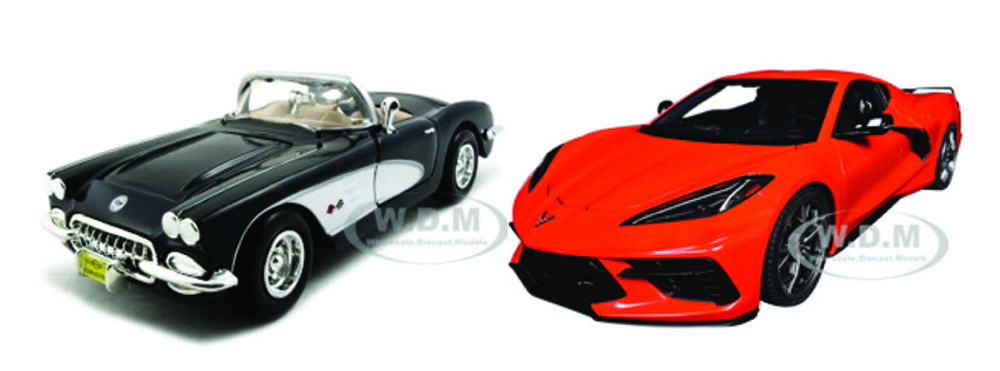
Click for Corvette Model Cars, C1 to C8 Generations
Get FREE Access to the Latest Posts